
Discussion Forum
This is a forum to discuss the gray areas of the English language for which you would not find answers easily in dictionaries or other reference books.
Do You Have a Question?
Latest Posts : Etymology / History
I had never thought I would ever wonder what “width” is until my 12-year old daughter came home one day and told me that her math teachers (not just one but two) told her that “width” in geometry is the vertical side of a rectangle. That to me was like saying up is down and down is up. How could this be?
It turns out that her teachers are not alone. Take a look at this page I came across while Googling on the topic. It says:
In the case of a square or a rectangle, the expression length (1) is commonly used instead of base and width (w) instead of height. In the case of a circle the expression diametre (d) is used.
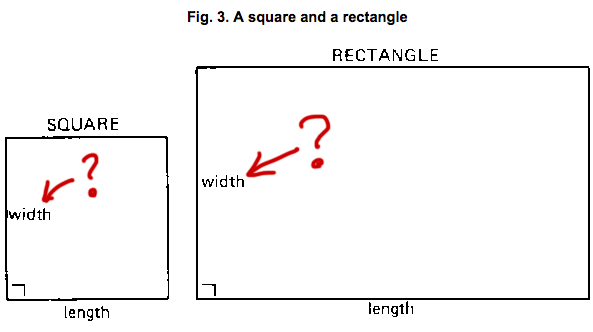
“Width instead of height” is very much like saying up is down. Where did this come from?
And, what is even more disconcerting is that the teachers are not aware of this ambiguous nature of “width.” Two other teachers told me that width is always the horizontal side, and another told me that she has heard others call the vertical side “width.” So, apparently, each is teaching their students in an authoritative manner their own definition of “width.” If a 12-year old is told by her math teacher that “width” in geometry refers to the vertical side, why should she doubt it? Unless, of course, she was also told that “width” can be vertical or horizontal (i.e. direction neutral, like “length”). But that is apparently not what is happening at school in New York City.
If we teach our kids that a triangle has three sides, we don’t want them thinking that the definition of “triangle” could be flexible as if it could have four or five sides. If the definition of “width” is not universal, they need to know that. Here is a case in point. The following question was in 2016 Common Core Math Test for Grade 6.
“A carpenter built three bookcases, A, B, and C, to stand next to each other along a wall. The total length of the wall is 456 centimeters. The carpenter will build two more bookcases, D and E, along the same wall. These two bookcases will have equal widths. The widths of bookcases A, B, and C are shown in the table blow.”
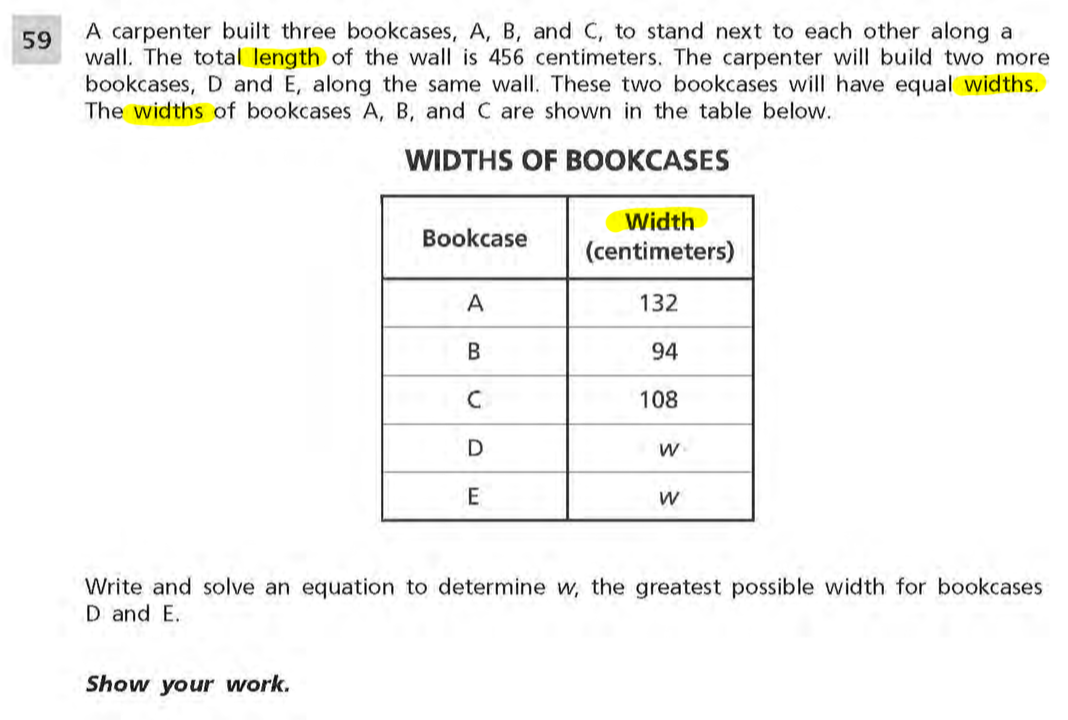
Now, if you were taught that in geometry, “width” means the vertical side and “length” means the horizontal side, you would have to be confused reading this question. The correct response would be, “But why should the ‘widths’ of the bookcases have anything to do with the ‘length’ of the wall in fitting the bookcases?”
My daughter tried to figure this out by drawing a bunch of bookshelves with different heights, and eventually gave up because the question made no sense to her.
In Merriam-Webster, the word “width” has no ambiguity: “the horizontal measurement taken at right angles to the length.” After all, the word “height” has no ambiguity, so why should we think “width” would?
But looking at the Oxford dictionary gives us a slightly different answer: “The measurement or extent of something from side to side; the lesser of two or the least of three dimensions of a body.”
In other words, in a rectangle, “the lesser of the two” sides would be called “width” regardless of the orientation. So, it appears that this is an American-versus-British issue, or is it? (Note the spelling of “diametre” on the page from fao.org quoted above.)
I have searched the forum and not found any reference to this matter. More and more, I’m hearing this kind of construction: “The fact of the matter is is that we need to...” or “The biggest problem is is that we don’t have...” I’ve even heard President Obama use it. At first blush, it bothers me. There’s no need for the second “is,” and no grammatical precedent. That is to say, I don’t know what it might spill over from. Furthermore, it seems like a fairly recent arrival. What do you think? Is this something we should eschew or embrace? Has anyone else heard and taken note of this?
What is the origin of the phrase “I’m just saying”?
Can anyone tell me when and how the adding of “ish” to the end of words got started? Do we lack such confidence in ourselves that we need to add “ish” like a disclaimer to our own words? When has the word become not word enough?
When did “issue” come to mean “problem” ?
When an why did “exactly the same” become “the exact same” and more recently “the same exact”?
There exists a claim that the word “man” originally only referred to people of unimplied sex. To restate, “man” always refereed to both male and female people.
The claims I found were made by sources known by some to be categorically highly unreliable, so I turn to you.
There are claims that “wer” or “were” was used at least for adult males.
The most reliable sources I’ve found to support that are
http://www.collinsdictionary.com/...
What evidence can you provide of the use of “were” or “wer” in english and the use of “man” and whether “man” changed over time with respect to gender or whether there was always ambiguity?
I just have the impression that the old proverbs that I heard as a child aren’t heard as much today. People just don’t seem to use them much anymore.
Of course this is hard to prove: maybe I am not mixing in the right circles; maybe there are newer proverbs that have replaced the older (proverbs change with each generation); maybe the media and/or gurus have picked up some and ignored others; maybe few make into print outside the tabloids and popular magazines.
As far as the printed word goes, of those I have looked at some seem to peak around the 1930′s and then trail off, only to recover somewhat over the last decade or two. “Actions speak louder than words” was the commonest one I found, 3:1 against “Beggars can not be choosers”.
What is your impression? Is proverb use declining or just new ones becoming popular?
More and more lately I’ve been hearing and seeing a change in the prepositions used in common phrases.
I’ve already commented on PITE about the use of “deal to” instead of “deal with” in NZ, and of course we have the age old debate about “different from/to”.
Recently I noticed some others creeping in:-
“what do you make to....” instead of “what do you make make of .....”
“I have no intention on.......” instead of “I have no intention of......”.
I’m sure there are others.
While there may be nothing grammatically wrong in this, it does sound a little strange and raises the question of why and how such usage arises.
Does it stem from a desire to be different just for the sake of being different?
Is it down to some kind of narcissism?
. when saying “what reading
Will words like fæces, archæologist, fœtus disappear from our language or should they be preserved?
Latest Comments
“Let his/him come in.”
- Guo
- April 23, 2024, 9:26am
In this context, "Let him come in" is the correct option. The use of "him" as the object pronoun is appropriate when referring to a person being allowed to enter. "Let his come in" would not be grammatically correct in standard English usage. Therefore, "him" is the most suitable choice for the completion of the sentence.
Is a definite article (the) necessary for "most"?
- Guo
- April 23, 2024, 9:25am
Both sentences are grammatically correct, but they convey slightly different nuances.
The first sentence, "What fascinates me the most about the textile industry is that it drives the economy of many third world countries," uses "the most," which emphasizes a specific aspect or element that is of greatest interest to the speaker. In this case, it suggests that among all the fascinating aspects of the textile industry, the economy-driving aspect is the most captivating to the speaker.
The second sentence, "What fascinates me most about the textile industry is that it drives the economy of many third world countries," omits "the" before "most." This version suggests a more general fascination with the textile industry overall, without specifically highlighting one particular aspect as the most fascinating.
Both versions are acceptable depending on the intended emphasis or tone of your writing. If you want to emphasize a specific aspect as the most fascinating, use "the most." If you want to convey a more general fascination without specific emphasis, use "most" without "the."
“I have two sons, Bill and Ben”: comma or colon?
- Guo
- April 23, 2024, 9:23am
In this case, using a comma is appropriate. A colon typically introduces a list or emphasizes a point, but in your sentence, the phrase "Bill and Ben" is simply providing additional information about your sons. Therefore, a comma is more suitable for this context.
Academic environments uphold principles of academic integrity, honesty, and ethical conduct, emphasizing the importance of citing sources on https://assignmentpay.com/coursework-writing-service/ , avoiding plagiarism, and maintaining academic honesty in all scholarly endeavors.
Past perfect with until
- Guo
- April 23, 2024, 9:20am
The correct sentence is: "She didn’t realize that she was addicted to nicotine until she had smoked ten cigarettes a day."
This is because the past perfect tense ("had smoked") is used to indicate an action that occurred before another past action or point in time ("realized"). In this case, smoking ten cigarettes a day happened before she realized she was addicted to nicotine. For more info read comments on https://kingessays.com/. Academic institutions promote research and scholarly inquiry across various fields, encouraging faculty and students to contribute to the advancement of knowledge through original research, publications, and creative works.
Treatment of abbreviations and superscript items in full capital case
- Guo
- April 23, 2024, 9:18am
Abbreviations and superscript items should be treated consistently in full capital case, maintaining their original formatting for clarity and accuracy.
Yes, both the superscripted letter and the abbreviation should be treated consistently in full capital case. So, for example, it would be: JANE McDONALD / WILLIAM DOE, JR.
“my” vs. “mine” in multiple owner possessive
- sujeetrepp443
- April 22, 2024, 10:36am
Maharashtra Board Solutions
Ecommerce Photogrphy Service
“You have two choices”
- William oyadomari
- April 19, 2024, 2:19pm
Hi what kind of English pain webpage is this?
“You have two choices”
- William oyadomari
- April 19, 2024, 2:19pm
Hi what is this English pain webpage about.
"badly miscalculated" — double negatives?
- user116298
- April 18, 2024, 1:37pm
After years of playing at different online casinos, I finally found my perfect choice at https://ak8aud.casino/ , where ak8 casino has become my favorite place to play. The wide variety of games, from slot machines to live dealer games, makes every experience I have unique. I am especially grateful for their bonus programs that greatly enhance my gaming sessions. The support team is always in touch and ready to help with any questions, which makes my stay on the site not only enjoyable but also safe.


Why Asian English Speakers Are Hard to Understand
You're saying that Asian people speaking English sometimes have a tough time being understood by native English speakers. It's not just about their accents or how they pronounce words. It's more about the differences in culture. For instance, Europeans might find it easier to communicate because they share similar cultures with Americans. But Asian cultures can be quite different, which makes it harder for them to give enough information when they talk. This can lead to misunderstandings, even if they speak perfectly. So, it's important to bridge these cultural gaps to understand each other better.